
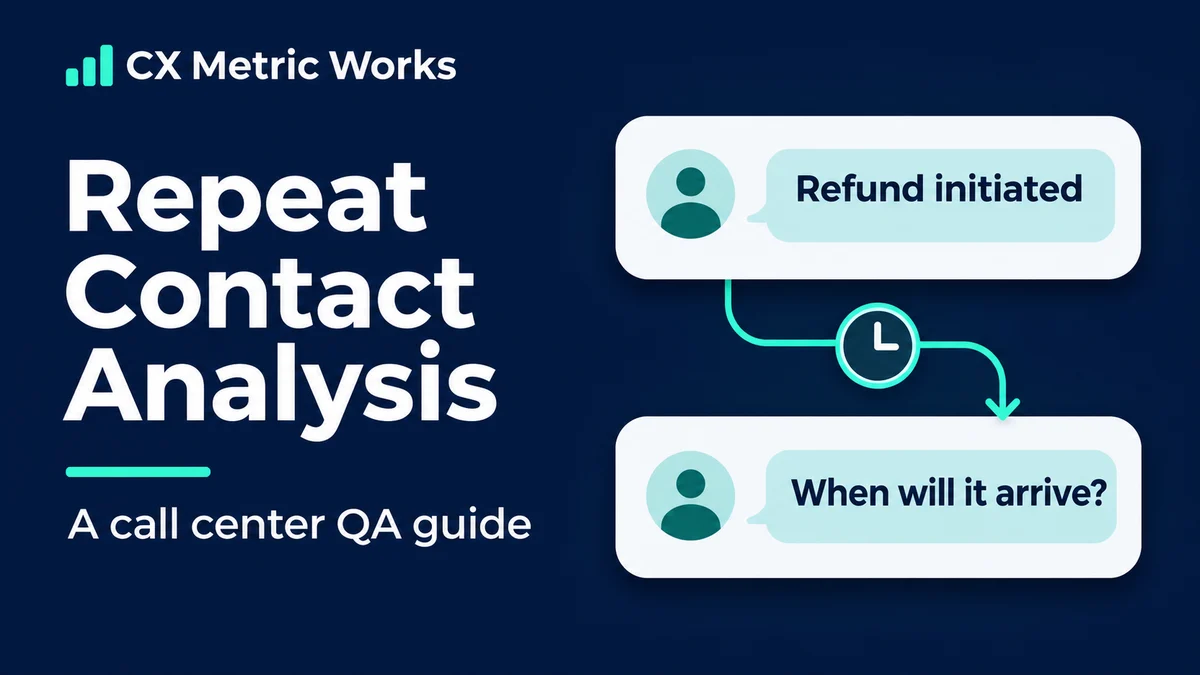
On Monday, a customer asks about a refund. The agent checks the order and replies, “Your refund has been initiated.” On Tuesday, the customer contacts support again: “When will the money reach my bank account?”
The first answer may be accurate and still leave the customer with a question. A repeat contact audit helps a quality analyst identify what brought the customer back and decide whether the first agent could reasonably have addressed it.
How we identified a repeat contact
In the customer service process I worked on, we counted a second contact as a repeat when the same customer contacted us within 48 hours about the same order or item, and both contacts had the same issue code. Once we found a match, we reviewed the first interaction to see whether the agent had given complete information.
The 48-hour window was our reporting rule. A customer who called after 50 hours might still have an unresolved problem, even though the contact fell outside that window. Equally, a customer might call twice in one afternoon about the same order: first about a refund for one item, then about a missing delivery for another. The order number alone would not make those calls a match.
How to audit the two contacts
1. Confirm the match
Compare the customer, timestamps, order or item, and issue codes. Then read what the customer actually asked on both occasions. If the codes match but the conversations concern different problems, document the discrepancy. A coding issue and a missed explanation are different findings.
2. Read the first conversation on its own
What did the customer ask? What could the agent verify at that moment? For a refund, compare the payment record, the agent’s exact wording and the guidance that applied to that transaction. A record showing that a refund was initiated supports the statement “we’ve initiated your refund.” It does not establish that the money has reached the customer’s bank account.
3. Identify what prompted the return
Use the customer’s words from the second interaction. “When should I expect the money?” suggests a question about timing. “I’ve just received a message saying the refund failed” introduces a new event. Both contacts could meet the repeat rule, but they call for different actions.
4. Record the repeat and the coaching finding separately
First record whether the contact meets the repeat rule. Then record what the evidence shows about the first agent’s response. If the timestamps and case details establish a repeat but the first recording is unavailable, a fair finding is: “Repeat confirmed; unable to assess whether the agent explained the timeframe.” A missing recording is not evidence of a missing explanation.
Worked example: “When will my refund arrive?”
In this hypothetical example, the same customer contacts support 24 hours later about the same item and refund issue code. The second contact qualifies as a repeat. The approved expectation in this example was 5–7 business days for the credit to appear in the customer’s bank account. Use the timeframe approved for the payment method and process you are reviewing.
Finding A: The first agent omitted the timeframe. The agent confirmed that the refund had been initiated. The customer returned specifically to ask when the money would arrive. Record the missing explanation as a coaching opportunity: giving the approved timeframe could have answered the follow-up question during the first contact.
Finding B: The first agent explained the timeframe. The recording confirms that the agent explained the 5–7-business-day expectation clearly. The customer called the next day for reassurance. Count the repeat, but do not coach the agent for omitting information they demonstrably gave.
Finding C: Something changed after the first contact. The agent correctly explained the timeframe, but a payment failure was recorded later. The customer returned about the failure notification. If the matching criteria are met, count the repeat and investigate the payment failure. Check its timestamp before deciding what the first agent could have known.
The two clocks answer different questions. After 24 hours, the second contact counts as a repeat under the 48-hour rule. That does not mean the refund is overdue. The expected bank-credit window in this example is 5–7 business days.
Write a coaching note the agent can use
“Improve first contact resolution” names the metric but gives the agent little to practise. For Finding A, a team lead could write:
You checked the payment record and correctly confirmed that the refund had been initiated. The customer called back the next day to ask when the credit would appear. On your next refund-status contact, explain both the verified status and the expected timing. In this case, you could have said: “Your refund has been initiated. The expected time for the credit to appear in your bank account is 5–7 business days.”
For follow-up, review another eligible refund interaction. Check whether the agent described the status accurately and gave the timeframe that applied to that transaction. This lets you assess the specific behaviour even when you have too few reviewed contacts to judge a change in the team’s repeat rate.
How to report the finding without overstating it
Keep three counts separate: how many contacts met the repeat rule, how many QA reviewed, and how many reviewed cases showed the specific coaching opportunity.
For example, suppose 30 contacts were flagged, QA reviewed 10, and four of those reviews found a missing timeframe. Write: “QA reviewed 10 of 30 flagged repeats. In four of the 10 reviewed cases, the first agent omitted the refund timeframe and the customer returned to ask about timing.” The causes of the other 20 repeats remain unknown.
Use the call center QA sampling guide to explain how you selected cases and the weekly QA report template to document findings and follow-up. A team lead reading the report should be able to trace each coaching recommendation back to the customer’s question, the agent’s answer and the information available at the time.