

A call center training needs analysis turns evidence about a knowledge or skill gap into a focused learning plan. It explains who needs support, what they should be able to do, and how the team will check whether that behaviour appears in later customer interactions.
A low QA score can start the investigation. The useful next step is to identify the behaviour behind the score and establish its cause. An agent who cannot find an updated policy needs a different response from an agent who understands the policy but struggles to explain it clearly.
This guide presents a practical workflow for Quality, Training and Operations teams, with a worked example and an Excel TNA template.
Experience and examples: This approach draws on my QA work reviewing accuracy, tool use, listening and communication findings. The delivery-status case and all figures below are hypothetical. They demonstrate the method without reproducing client or employee records.
What should a call center training needs analysis answer?
A useful TNA identifies the task, the performance gap, the people affected, and the learning needed to close a confirmed knowledge or skill gap. It should give a trainer enough information to design a relevant activity and give the supervisor a behaviour to observe afterward.
- Expected behaviour: What should happen during the interaction?
- Observed gap: What does the audit evidence show?
- Cause: What supports the diagnosis?
- Response: Which training, coaching or operational action fits that cause?
- Follow-up: Who will check application, when, and using which evidence?
The U.S. Office of Personnel Management describes needs assessment as investigating the gap between required and current performance, including its causes and possible solutions. It also explains that management changes may be needed alongside training. Read OPM’s training needs assessment guidance.
1. Define the behaviour before analysing the score
Replace broad labels such as “poor communication” with an observation a reviewer can locate in the interaction. For example: the customer asked for the next step, but the agent repeated the order status without explaining what would happen next.
Write the expected behaviour beside it: explain the verified status, the approved next step, and any relevant uncertainty. This gives the trainer a specific task to practise and the QA reviewer a consistent assessment point.
Check the current policy and rubric before treating a behaviour as a defect. If reviewers disagree about what the standard requires, use QA calibration to resolve the interpretation before sending the finding for training.
2. Organise the evidence and define the denominator
Group findings by behaviour, contact reason, cohort or another relevant category. Keep the review window and selection method visible. A set of interactions selected because of negative feedback should be described as a targeted review; our call center QA sampling guide explains the selection limits.
Decide whether a count represents affected interactions, individual defects, or agents. One interaction can contain several defects. Adding all defect counts and dividing by interaction count may produce a different measure from the percentage of interactions containing a particular defect.
For the worked example in this guide, count each eligible interaction once if it contains the defined target defect, even when that behaviour occurs repeatedly within the same interaction.
Observed target-defect rate = interactions containing the target defect ÷ eligible reviewed interactions × 100.
This rate describes the reviewed sample. Keep the selection method and population in view when interpreting it.
3. Validate the cause before assigning training
Use a short knowledge check, an observed scenario, a tool walkthrough, or a discussion supported by the interaction evidence. A reviewer can then distinguish what the agent knows from what they can demonstrate and what the operating environment allows them to do.
| Possible cause | Evidence to check | Possible response |
|---|---|---|
| Knowledge gap | The agent cannot identify the approved action or explain the current rule. | A focused refresher, reference practice and a knowledge check. |
| Skill gap | The agent knows the rule but cannot apply or explain it accurately in observed practice. | Scenario practice with feedback on the specific behaviour. |
| Tool or access problem | The approved action is blocked, unavailable or failing during the walkthrough. | Investigate the tool or access issue and define an approved fallback. |
| Process or policy ambiguity | Guidance conflicts or responsibility for the next step is unclear. | Clarify ownership and guidance, then communicate the agreed standard. |
| Follow-through gap | The agent demonstrates the task but misses a required action in live work. | Investigate the circumstances, coach the action, and verify completion. |
These are investigation prompts, not automatic diagnoses. More than one cause can exist. For example, a difficult workflow may also reveal a training need around the approved escalation path.
4. Set priorities and write a learning objective
Consider customer impact, severity, recurrence, the number of people affected, and programme requirements. Escalate a serious issue through the applicable process while planning the longer-term response. Your critical-error rules should guide that decision.
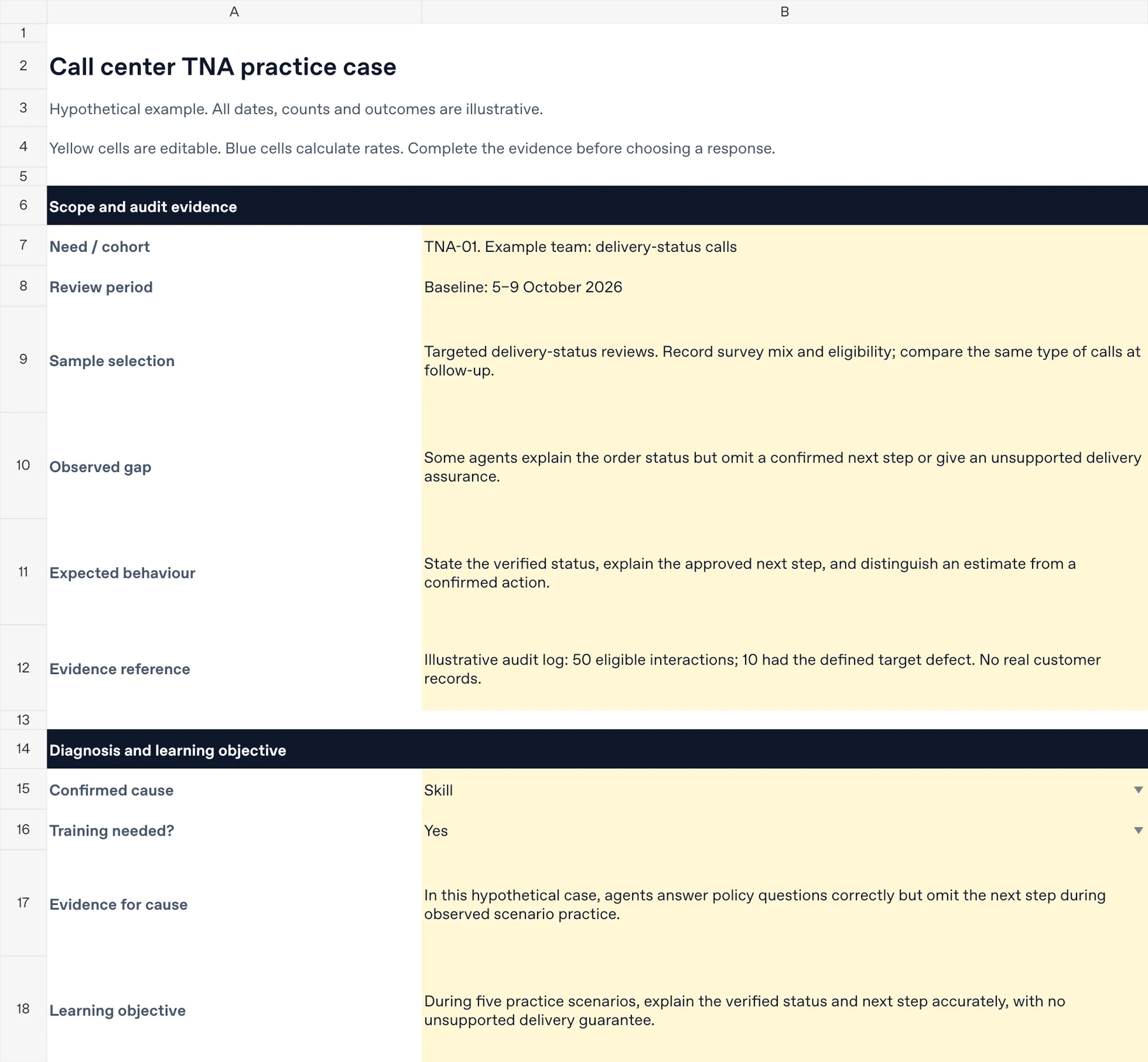
For a confirmed learning need, write an objective that can be demonstrated. “Attend a communication refresher” records participation. A more useful objective is: “During five delivery-status scenarios, explain the verified status and approved next step accurately, without adding an unsupported delivery guarantee.”
The number of scenarios is an example, not a required minimum. Select practice that covers the situations the learners need to handle.
5. Assign actions that match the gap
In my QA work, training-needs reviews brought together accuracy, tool-navigation and communication observations. The associated plans included targeted refreshers, individual feedback, call listening and clearer example explanations. The useful connection was between a specific finding and the response chosen for it.
Record an action owner, due date and evidence of completion. Keep responsibility for delivering the learning activity separate from responsibility for checking later application.
For example, a trainer can lead scenario practice, a team lead can observe and coach, and a QA reviewer can assess fresh interactions against the agreed behaviour. These roles are illustrative; assign them according to your team’s structure.
CDC’s training-development guidance recommends objectives aligned with learning goals, relevant practice and assessment, and follow-up support. These are useful design principles when building a focused activity. Read CDC’s Quality Training Standards.
Worked example: explaining delivery status clearly
Hypothetical case: A targeted review of delivery-status calls finds that some agents describe the order status but omit a clear next step or add an unsupported delivery assurance. A knowledge check is correct, but observed scenario practice reveals a gap in applying the explanation.
The plan uses scenario practice, behaviour-specific feedback, and an example explanation checked against approved guidance. Follow-up reviews use the same contact type and target-defect definition, with any selection differences recorded.
| Measure | Baseline | Follow-up |
|---|---|---|
| Eligible reviewed interactions | 50 | 40 |
| Interactions containing the target defect | 10 | 4 |
| Observed defect rate | 20% | 10% |
The observed defect rate decreases by 10 percentage points: 20% − 10%. This describes the difference between the two illustrative samples. It does not prove that training alone caused the change.
Review case mix, sample selection and any other process changes before drawing a broader conclusion. Keep the actual behaviours and evidence available alongside the rates.
6. Check application after training
Separate activity completion from application. Attendance confirms participation. A knowledge check shows what a learner can answer. Observed practice shows what they can demonstrate in that setting. Later eligible interactions help you assess whether the behaviour is being applied at work.
Agree on the follow-up window and success criterion before delivery. For the example workbook, the illustrative criterion is that at least 90% of eligible follow-up calls have verified status, an approved next step and no unsupported delivery guarantee. Choose your own criterion from the task, risk and programme requirements.
Record what remains unresolved. A completed refresher can still leave a tool problem or an unclear policy owner that needs a separate action. Use a weekly call center QA report to track follow-up findings, action owners and due dates, keeping completed training separate from evidence of behaviour change.
Free call center TNA template (Excel)
The CX Metric Works workbook contains a TNA plan sheet and a clearly labelled Practice case. Use one plan per learning need or cohort and duplicate the blank sheet for another need.
Download free Excel TNA template
Excel (.xlsx), approximately 10 KB. No signup required.
- Define the cohort, review period, selection method and observed gap.
- Describe the expected behaviour and retain a reference to the supporting evidence.
- Record the cause and whether training is needed, with evidence for that decision.
- Write the learning objective and assign actions, owners and due dates.
- Set the follow-up window, selection approach and success criterion.
- Enter the baseline and follow-up counts, then record the interpretation and next action.
Yellow cells are editable. Blue cells calculate the observed rates and reduction in percentage points. Blank counts leave results blank. Zero affected interactions is a valid result; zero reviewed interactions does not provide a rate.
Frequently asked questions
What is the difference between TNA and a training calendar?
A TNA explains the learning need and the evidence behind it. A training calendar schedules delivery. Use the analysis to decide what belongs on the calendar, who needs it and how application will be checked.
Should everyone receive the same refresher after a QA defect?
Check the scope first. An individual skill gap may need focused coaching, while a shared knowledge gap may justify a group refresher. A common tool problem may need an operational fix and a briefing on the approved workaround.
Can a better QA score prove the training worked?
A score change is one piece of evidence. Check the target behaviour, selection mix, scoring consistency and other changes affecting the result. Use your weighted QA scoring method consistently, and keep behaviour-level evidence alongside the overall score.
How often should the training needs analysis be reviewed?
Use a review schedule that fits the risk and pace of change. Revisit an open need after the agreed follow-up, when defects recur, or when policy, tools or responsibilities change. Record the next review rather than relying only on a recurring training event.
References and methodology
The operational approach draws on Azim Siddiqui’s QA experience. The workbook and delivery-status case are original teaching examples, with hypothetical counts and no claimed client performance improvement. The external references provide training-development background.